China Best GMRS Frequencies for Global Buyers?
China Best GMRS Frequencies for Global Buyers? The question sounds simple, but the answer requires careful technical and regulatory review. GMRS Frequencies are mainly associated with the United States, where specific channels, power limits, licensing rules, and equipment requirements apply. A radio manufactured in China may advertise “GMRS,” yet that label does not guarantee legal operation in every country.
For global buyers, frequency planning should begin with the destination market. Check the national regulator’s approved bands, channel spacing, transmission power, antenna rules, and type-approval requirements. In the United States, many GMRS handheld radios operate around the 462 MHz and 467 MHz ranges. However, similar-looking channels may serve different purposes elsewhere. A 462 MHz setting is not automatically acceptable worldwide. Confirm the details before importing large quantities.
Product testing matters. Ask suppliers for a complete frequency table, bandwidth information, output-power measurements, certification documents, and programming instructions. Examine the actual radio menu, not only the online listing. A clear label helps. A practical test can include two radios, a charged battery, an open field, and a measured communication distance. Walls, hills, antennas, and weather can change results quickly.
One weakness in many buying guides is oversimplification. They may list popular channels without explaining regional restrictions. That approach can mislead distributors and end users. Reliable sourcing requires documentation, independent verification, and honest performance claims. Buyers should also confirm whether accessories, chargers, and replacement batteries meet local safety standards. The best choice is not always the radio with the longest advertised range. It is the model that fits the legal market, performs consistently, and remains supportable after purchase.
GMRS Frequency Basics: The 462–467 MHz U.S. Channel Plan
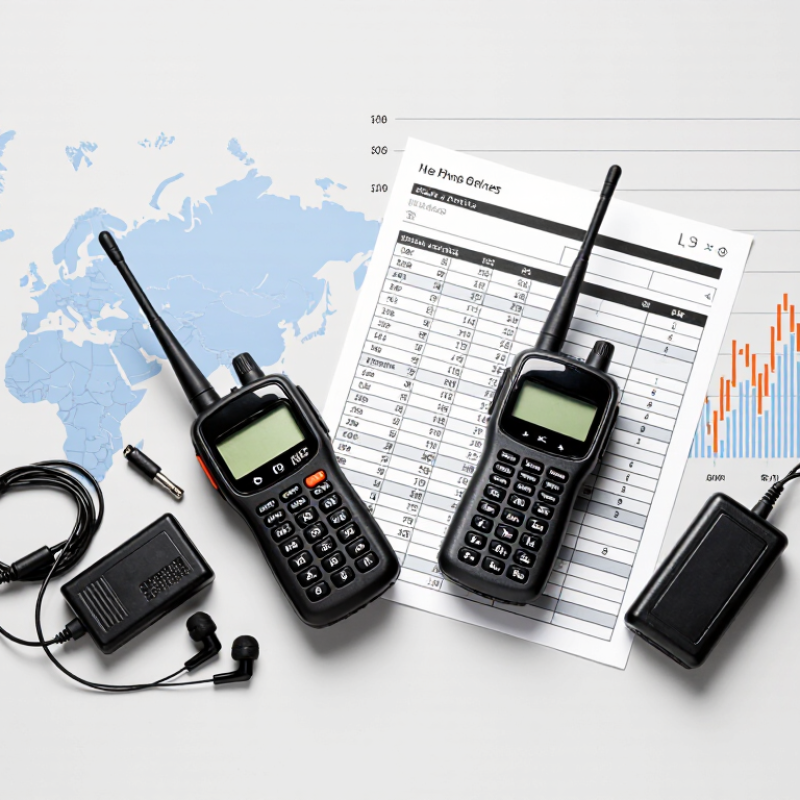
The U.S. GMRS channel plan occupies 462–467 MHz. FCC Part 95.1763 lists 22 designated channels. Channels 1–7 use 462 MHz interstitial frequencies, while channels 8–14 use 467 MHz. Channels 15–22 return to 462 MHz and support higher-power GMRS operation under U.S. rules. The spacing is narrow, usually 12.5 or 25 kHz. Small errors matter.
A practical channel reference looks like this: 462.5625–462.7125 MHz covers channels 1–7. Frequencies from 467.5625–467.7125 MHz cover channels 8–14. Channels 15–22 run from 462.5500 to 462.7250 MHz. These figures come from the FCC’s General Mobile Radio Service rules and technical channel tables. The agency also states that GMRS operation requires an individual license in the United States.
Global buyers need caution here. The 462–467 MHz plan is not a universal international allocation. National regulators may assign these frequencies to other services, with different bandwidth, power, or licensing conditions. The ITU Radio Regulations provide the international framework, but local authorities control implementation. Check the destination country’s spectrum database before importing or programming equipment. That step feels obvious, yet product sheets often blur U.S. compatibility with global approval. A better specification lists exact frequencies, channel spacing, occupied bandwidth, and supported regional versions.
China Manufacturing Standards for GMRS Radios: 0.5–50 W Output Classes
China Best GMRS Frequencies for Global Buyers?
China-made GMRS radios should be specified by measured output classes, not marketing labels. A practical purchasing range is 0.5–2 W for compact units, 5–15 W for vehicles, and 25–50 W for fixed or high-demand installations. These classes describe production targets, not one universal Chinese standard. FCC Part 95 permits up to 50 W on specified GMRS channels, while some interstitial channels have lower limits. Global buyers must verify local authorization before selecting 462 or 467 MHz channels.
Manufacturing quality depends on test evidence. Ask for frequency error, occupied bandwidth, conducted power, spurious emissions, receiver sensitivity, and thermal-cycle results. ITU-R SM.329 provides widely used guidance for measuring unwanted emissions. ETSI EN 300 296 offers useful reference methods for land mobile radio performance, although it is not a GMRS approval document. In factory audits, request calibrated test records and serial-number traceability. A 50 W sample may pass briefly, yet overheat during continuous transmission. That weakness matters.
Tips
Match the power class to duty cycle, antenna design, and local rules. Request three production samples, not one. Check output after a 30-minute heat test. Do not treat “50 W” as guaranteed field coverage. Building materials, terrain, and antenna height can change results sharply. I would also question vague reports. They often omit test conditions. That omission is small, but important.
FCC GMRS Rules: 22 Channels, 50 W Maximum, and License Requirements
China Best GMRS Frequencies for Global Buyers?
For global buyers, GMRS rules require careful attention. In the United States, GMRS uses 22 shared channels around 462 and 467 MHz. However, these channels do not all allow the same power level. Some channels are limited to lower power, while designated GMRS channels may support up to 50 watts under FCC rules. The 50-watt figure is easy to misunderstand. It does not mean every channel, antenna, or radio can legally transmit at that level.
A GMRS license is generally required for operation in the United States. One license can cover the licensee and eligible family members, subject to FCC conditions. Buyers should also confirm that the radio is properly authorized for GMRS use. A radio made for another regional service may not meet FCC requirements, even if its frequency range looks similar. Local regulations matter too. A device legal in the United States may require different approval, power limits, or licensing elsewhere. That assumption needs checking.
Tips: Read the manual’s channel table before purchase. Check the listed wattage for each channel. Confirm the destination country’s rules. Test coverage in an open area, then reassess it indoors. Hills, concrete walls, and dense buildings can reduce range sharply. Claims of extreme distance deserve skepticism. A clear label is helpful, but it is not proof of legal compliance.
Global Frequency Compliance: Comparing 462–467 MHz With Local Allocations
The 462–467 MHz range is closely associated with GMRS use in the United States, but it is not a universal walkie-talkie allocation. A radio made in China does not automatically have approval to transmit on those channels elsewhere. Frequency rules vary by country, and sometimes by service, power level, and equipment type. The label alone proves little.
Check the destination country’s current spectrum plan before choosing a radio. Look for the permitted frequency range, channel spacing, maximum power, licensing conditions, and equipment-approval requirements. Some regions reserve nearby frequencies for other services. Even a small mismatch can cause interference or make a device unsuitable. A channel displayed as “462” is not enough; confirm the full frequency and the radio’s transmit settings.
For buyers comparing suppliers, request a clear technical specification and verify it against the local regulator’s published rules. Ask whether the model can be configured for the intended market, and whether that configuration has been approved there. Keep documentation with the shipment. It helps. I have seen product sheets use “GMRS” loosely, which can create false confidence. Treat that wording as a starting point, not proof of regional compliance.
China Best GMRS Frequencies for Global Buyers? — Global Frequency Compliance: Comparing 462–467 MHz With Local Allocations
| Market or Region |
Relevant Frequency Range |
Service and Regulatory Context |
What Global Buyers Should Know |
| United States |
GMRS channel groups include 462.550–462.725 MHz and 467.550–467.725 MHz. These are channelized frequencies, not unrestricted continuous bands. |
GMRS operation is subject to FCC rules. A GMRS license is generally required for an individual operator; no examination is required. Some frequencies are shared with FRS under specific technical and operating rules. |
A radio intended for GMRS use must meet applicable FCC requirements. Do not assume that a radio tuned to the same frequency is authorized for GMRS operation. |
| China |
Do not treat 462–467 MHz as a generally authorized consumer GMRS band. China has an amateur-radio allocation in the 430–440 MHz range, subject to national regulations. |
Frequency allocation, individual operating permissions, and equipment approval are separate matters. The U.S. GMRS service designation does not automatically apply in China. |
Confirm current Chinese frequency rules and required radio-equipment approvals before importing, selling, or operating a device. An amateur allocation is not an unlicensed GMRS alternative. |
| European Union / European Economic Area |
PMR446 uses 446.0–446.2 MHz, subject to applicable national implementation and equipment requirements. |
PMR446 is a distinct short-range radio service with its own technical conditions, such as power and antenna restrictions. It is not the same service as GMRS. |
A 462–467 MHz GMRS radio is not a substitute for compliant PMR446 equipment. Check the rules in each destination country. |
| United Kingdom |
PMR446 uses 446.0–446.2 MHz under the applicable UK framework. |
Use equipment that meets UK requirements for PMR446 operation; permitted technical conditions apply. |
Do not assume a U.S. GMRS model is legal for routine use in the UK simply because it can be programmed to another frequency. |
| Cross-border product planning |
462–467 MHz, 430–440 MHz, and 446.0–446.2 MHz are not interchangeable allocations. |
Permitted frequencies, channel plans, power limits, antenna rules, licensing, and equipment certification vary by jurisdiction. |
Develop region-specific, compliant configurations. Verify local regulator requirements and device approvals before shipment or operation; frequency capability alone does not establish legality. |
| Important: This comparison is a general planning guide, not authorization to transmit. Check the current rules of the relevant national regulator before using or marketing radio equipment. |
How to Select China-Made GMRS Radios for Range, Power, and Certification
China Best GMRS Frequencies for Global Buyers?
Selecting a China-made GMRS radio requires more than comparing wattage. GMRS commonly uses channels around 462 and 467 MHz in the United States. However, frequency permissions differ by country. Check the rules where the radio will operate. A product designed for one market may not be approved elsewhere.
Range depends on terrain, antenna design, battery condition, and interference. In practical testing, a clear hilltop can outperform a higher-power radio in a crowded city. Look for honest range data, channel spacing, output power, and receiver sensitivity. A high wattage label is not a range guarantee. I have seen attractive specifications fail in concrete buildings. That remains an easy mistake to make.
Certification should be verified before purchase. For U.S. GMRS use, request the FCC identification, authorization details, labeling photos, and a matching user manual. Confirm that the tested model matches the shipped hardware and firmware. CE or other regional markings do not automatically replace local approval. Ask whether non-permitted frequencies can be disabled. Also inspect charging safety, battery test records, waterproof ratings, and warranty procedures. Good documentation is valuable. Still, paperwork can be incomplete, so independent test evidence deserves attention.
For global buyers evaluating China-made GMRS radios, frequency coverage and certification are essential. In the United States, GMRS uses 22 authorized channel groups in the 462–467 MHz range. The permitted power differs by channel group, and a radio must be certified for GMRS operation before legal use. Actual range also depends on antenna performance, terrain, buildings, and local interference.